Liquidity: how withdrawals work
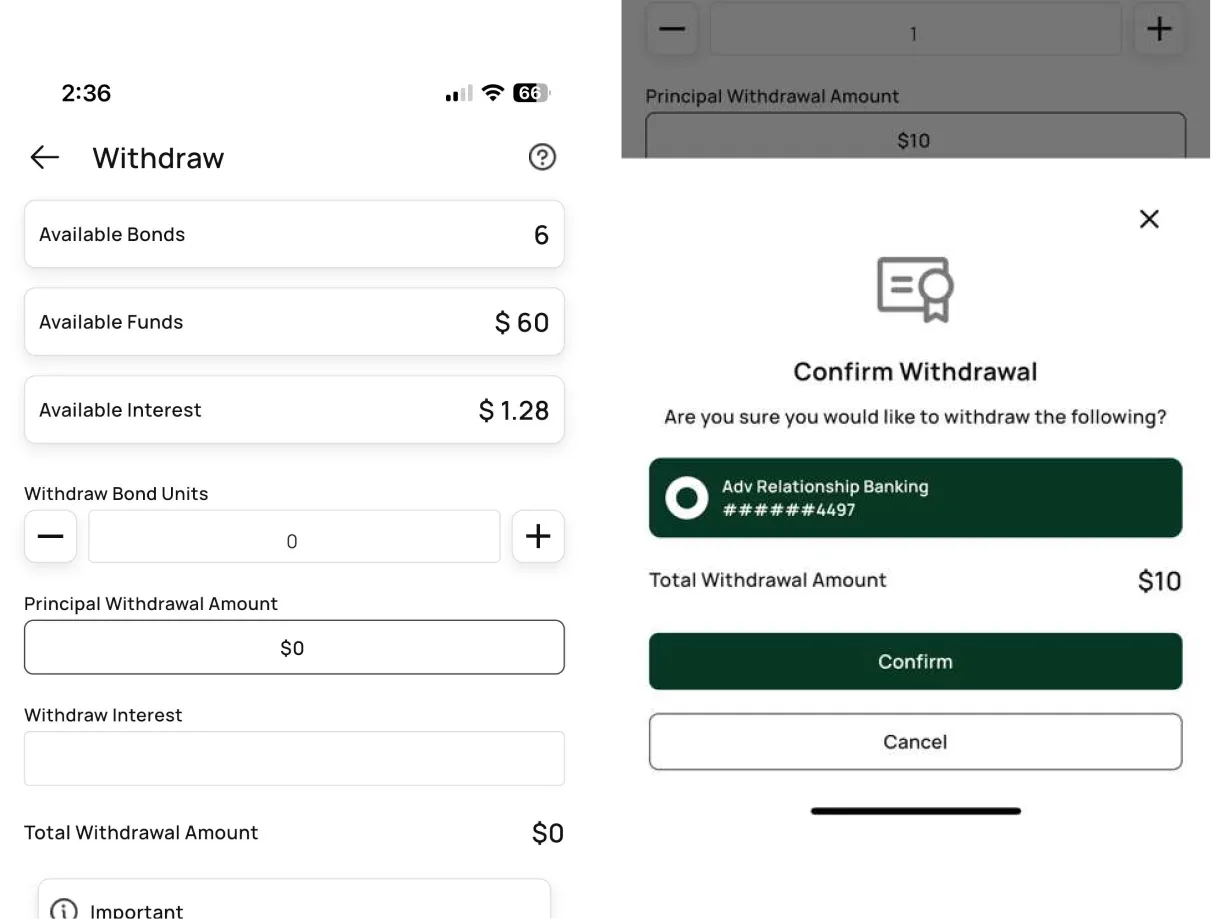
There is no fixed term, no lock-in period and no withdrawal fee. You can request a redemption of your bonds at any time from your dashboard. To keep the process fair and orderly for every investor, redemptions follow the timeline set out in the bond terms:
Withdrawal request
Payment timeline
Up to $50,000 within a 30-day period
Within 5 business days of the request
More than $50,000 within a 30-day period
Within 30 business days of the request
Interest keeps accruing on your bonds until they are redeemed. Before you can withdraw a new deposit, it must first clear your bank, and bank transfer times can vary. Withdrawals are funded from cash reserves, U.S. Treasury bills, loan repayments as loans mature, and ongoing investor inflows. To date, CREB has honoured redemption requests from its investors under these terms.
What “withdraw anytime” does and does not mean
“Withdraw anytime” means you can submit a redemption request whenever you choose, with no lock-in and no penalty. It does not mean CREB works like a bank account with instant, insured access to your money. As our offering circular explains, CREB does not keep a separate sinking fund, and it would not be able to meet redemption requests if every investor asked to redeem at the same time. If requests exceeded available liquidity, CREB could need to sell assets, arrange financing or seek support from its parent company, and investors could face delays.
For this reason, we suggest investors keep their emergency savings in an insured bank account and invest in CREB with money they do not expect to need at short notice.
Understanding the risks
A legitimate investment company tells you what can go wrong, not just what can go right. The full list of risk factors is in our offering circular, and we strongly encourage you to read it. Here are the most important ones in plain language.
CREB is not a bank deposit. CREB bonds are not insured by the FDIC, are not protected by SIPC, and are not guaranteed by any government agency or private insurer. You could lose some or all of the money you invest.
Credit risk of the issuer. When you buy a CREB bond, you are lending money to Compound Real Estate Bonds II, Inc. The bonds are unsecured, so your repayment depends on the issuer's ability to pay. If the issuer ran into serious financial difficulty, bondholders would be general unsecured creditors.
Real estate and borrower risk. An economic downturn, rising interest rates, falling property values or problems with a particular property could lead to late payments or defaults. Recovering money through foreclosure can take time and cost money, especially across different states or countries.
Concentration risk. A growing loan book can at times be concentrated in a small number of larger loans, so the performance of a single loan can have a bigger impact on the portfolio.
Liquidity risk. Withdrawals are processed under set timelines and depend on available liquidity. There is no public market for CREB bonds, and they cannot be transferred without the company's approval.
Interest rate and reinvestment risk. If rates fall, borrowers may repay early and new loans may be made at lower rates.
Terms of the bond. The bond terms can be modified with the consent of holders of a majority of outstanding principal, and any change approved that way applies to all bondholders. Investors also agree to resolve disputes through arbitration unless they opt out within 30 days of first accepting the purchase agreement.
How the bond behaves under stress
Scenario 1: Property values fall 20%. On a loan made at 55% to 60% LTV, the borrower's equity absorbs the first 40% or more of any decline. A 20% fall would reduce that cushion but would not, on its own, put the loan underwater. A severe, broad-based downturn, especially one affecting one of the larger loans, could still impair returns.
Scenario 2: Many investors withdraw at once. Withdrawals are funded first from the cash and Treasury reserve. If requests ever exceeded the reserve, CREB would need to wait for loan repayments, sell assets, arrange financing or seek support from its parent, which has no contractual obligation to provide it. Payments could be delayed.
Scenario 3: CREB itself faces financial difficulty. Because CREB bonds are unsecured, bondholders do not hold a priority claim on any specific loan or property. If the issuer became insolvent, bondholders would be general unsecured creditors, and recovery of principal would not be guaranteed.
How to manage these risks. CREB's structure is designed to reduce risk, not eliminate it. Invest only money you can afford to have tied up or to lose, keep your emergency fund in an insured account, and treat CREB as one part of a diversified portfolio rather than your only savings.